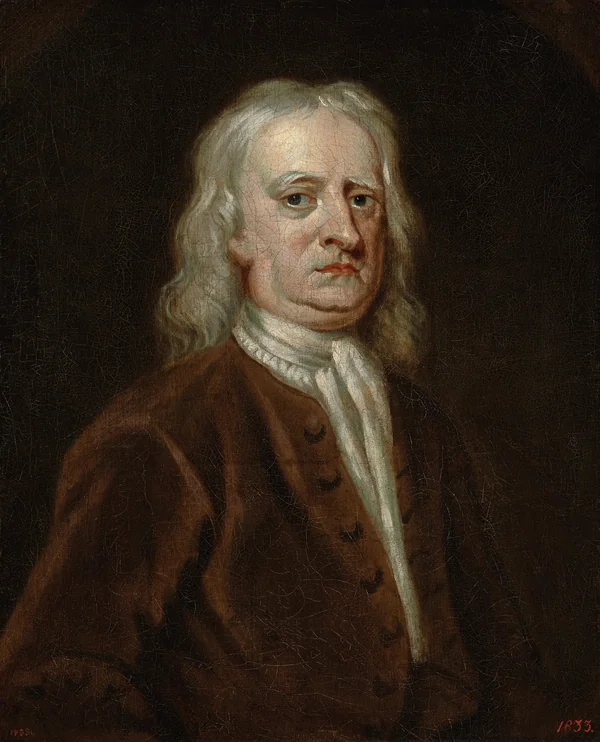
The man who unfolded the architecture of the universe — and expected it to end soon.
Newton gave the world the calculus, the laws of motion, and universal gravitation — remaking what it means to know anything about the physical world. His Principia Mathematica (1687) is among the most consequential books ever written.
Yet he spent more of his life as an alchemist and biblical chronologist than as a physicist — obsessively hunting the hidden architecture of Scripture and the philosopher's stone in equal measure. The equations were, to him, a byproduct.
He was solitary, vindictive, and brilliant beyond contemporary measure. He died a virgin, never married, rarely laughed, and waged a forty-year war against Leibniz over the invention of the calculus. He expected the world to end, through careful calculation, no sooner than 2060.
What you are about to encounter is not a dramatisation. Newton speaks here from the aggregate of his actual writings — the Principia, the Opticks, his alchemical notebooks, his unpublished theological manuscripts, and decades of private correspondence. No invention. No flattery.
He will answer your questions as he wrote: with mathematical precision when the matter admits of it, with guarded Biblical authority when it does not, and with sharp impatience when he believes you are wasting his time. He does not suffer fools — but he may, on occasion, suffer curiosity.
Ask him whether God was necessary after the equations. Ask him what he was truly working on while the world read the Principia. Ask him about Leibniz, and watch the temperature drop.
If I have seen further, it is by standing on the shoulders of giants.
I do not know what I may appear to the world; but to myself I seem to have been only like a boy playing on the sea-shore, and diverting myself in now and then finding a smoother pebble or a prettier shell than ordinary, whilst the great ocean of truth lay all undiscovered before me.
Isaac Newton · Recollection recorded by Joseph Spence, Anecdotes · c. 1730