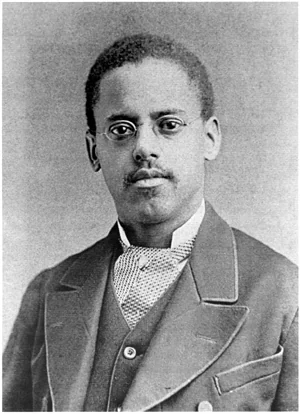
Born in Chelsea, Massachusetts to George and Rebecca Latimer — enslaved people who had escaped Virginia by sea — Lewis Latimer grew up in poverty and enlisted in the Union Navy at fifteen. What came next was one of the most quietly extraordinary careers in the history of American technology.
Self-taught in mechanical drawing at the patent firm Bell, Cheever & Symonds, Latimer drafted Alexander Graham Bell's original telephone patent in 1876. He went on to perfect the carbon filament process that made the incandescent bulb commercially viable, received U.S. Patent 252,386 in 1882, and personally supervised the installation of electric light systems in New York, Philadelphia, Montreal, and London. He joined Thomas Edison's inner circle as the only Black member of the Edison Pioneers — and was one of the few who could both design the systems and write about them.
He wrote poetry. He gave free English lessons to newly arrived immigrants. He painted in watercolor. He composed music. History gave the credit to others.
Lewis Latimer operated at the intersection of genius and invisibility. He could draft a patent with the precision of an engineer and describe electric light in prose a layperson could understand — yet for most of the twentieth century, the textbooks remembered Edison and Bell and left Latimer's name in the footnotes.
This conversation draws on Latimer's own writings: his Incandescent Electric Lighting manual of 1890, his poetry collection, his patent filings, and the oral histories of his colleagues in the Edison Pioneers. Ask him about invention, credit, race, artistry, and what it means to build a world that others will inhabit.
Consider asking: whether the myth of the lone inventor is still doing damage today. What it meant to be the only Black member of Edison's inner circle. How he thought about the ownership of an idea when his name so rarely appeared in the newspapers that celebrated what he built.
"We have, by careful study of what has been written on this subject, arrived at a point where we may almost assert that the electric light is a fixed fact, and that within a comparatively short time it will be as common as the gas-light is today."Lewis Howard Latimer — Incandescent Electric Lighting: A Practical Description of the Edison System, 1890