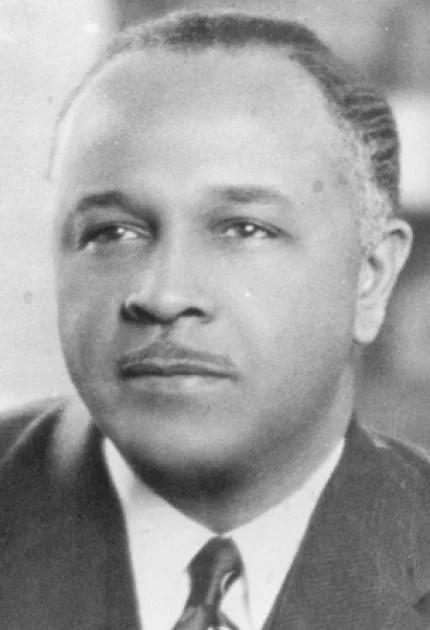
Born in Montgomery, Alabama under the weight of Jim Crow, Percy Julian was told that chemistry was not for men like him. He earned his doctorate from the University of Vienna in 1931 — one of the world's finest scientific institutions — and returned to an America that denied him professorship after professorship on account of race.
Undeterred, Julian joined the Glidden Company and transformed soybeans into a pharmaceutical revolution, synthesizing progesterone, testosterone, cortisone, and physostigmine at industrial scale — collapsing prices, opening treatments to millions who could not afford them, and earning over 130 patents across his career.
When he moved his family to Oak Park, Illinois, his home was bombed. Twice. The molecules he built relieved suffering around the globe while his neighbors tried to drive him out.
Percy Julian synthesized cortisone from soybean stigmasterol at a cost so low it transformed rheumatoid arthritis treatment from a luxury into a common therapy. He holds his own in the annals of twentieth-century science not as a curiosity but as one of its central figures — yet the standard histories have spent decades placing him at the margins.
His intelligence was recognized early, blocked systematically, and ultimately triumphant in the marketplace when the academy refused him. The questions worth pressing him on are not simply about chemistry — they concern power, pricing, access, and what a society tells itself about merit when it bombs a Nobel-caliber scientist's house.
"I have had one goal in my life — to prove that it doesn't matter where you come from. It matters where you are going and what you give to the world along the way."
Percy Lavon Julian — Interview, c. 1960sThis conversation is trained on Julian's published papers, interviews, patent filings, his testimony before Congress on drug pricing, and biographical records from the Julian Research Foundation. Bring your hardest questions about race, science, and pharmaceutical capitalism.
“I have been a Negro all my life, and I have never had the feeling that being a Negro was a handicap to me. I have had the feeling that being a Negro was a challenge — and I have tried to meet that challenge.
Percy Lavon Julian · Ebony Magazine, 1947